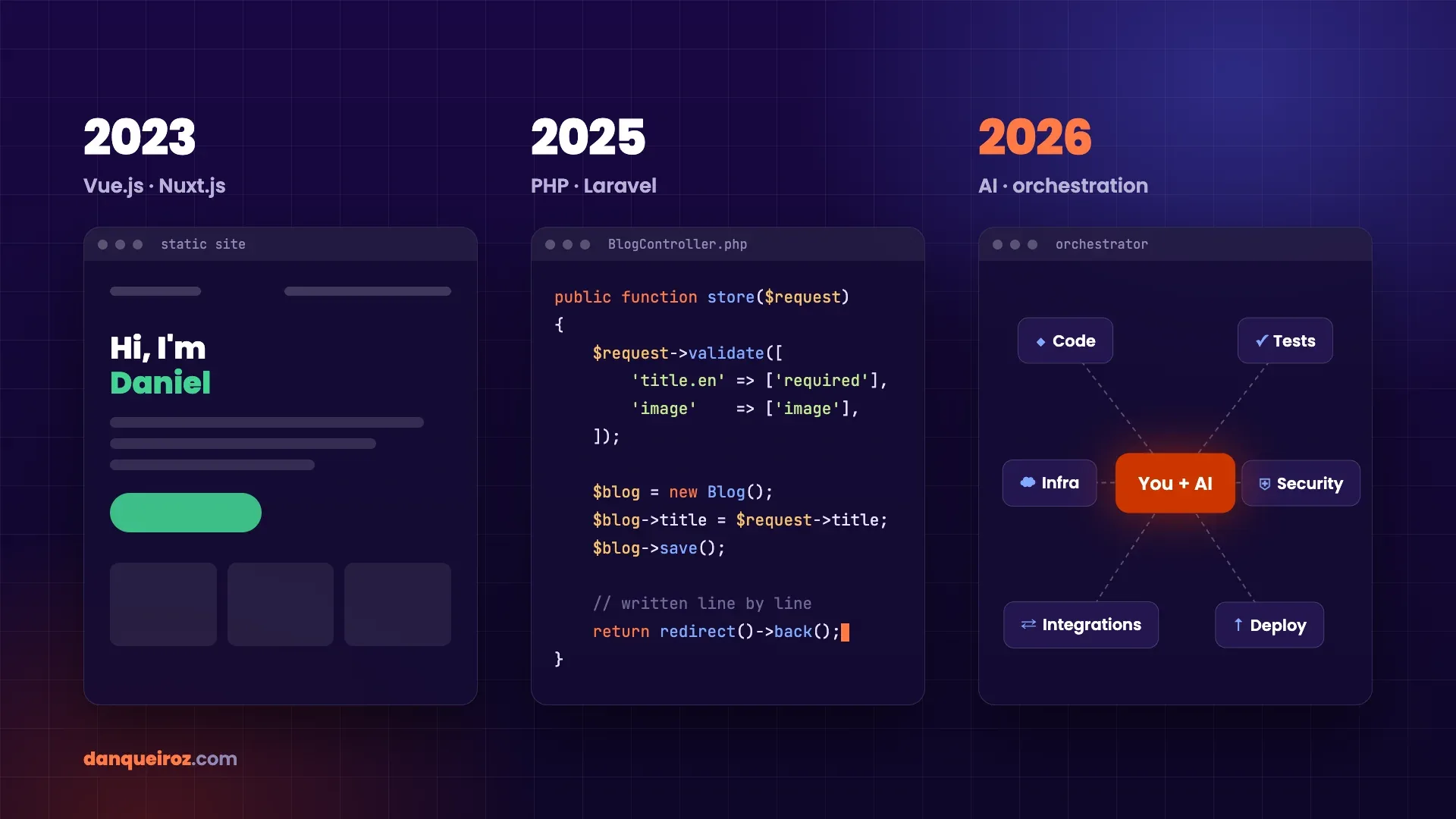
Three years ago, I launched the first version of my portfolio website: a static site built with Vue.js and Nuxt.js, made to showcase my services and projects and to receive contacts (I announced it here). It did the job, but any change, however small, meant editing the code.
Almost a year ago, I rebuilt it from scratch, this time 100% customizable through an admin panel. And I switched languages: I chose PHP with Laravel precisely to go deeper into back-end development (I announced it here). Since then, the way I work has completely changed. And what surprised me most was not how much AI started doing, but how much I had to learn to use it well.
How the new version was built
I wrote practically all of the site's code, from the admin panel to the public pages. With the admin panel, I could add, edit and remove any content without touching the code, and the site gained a blog, a contact form and three languages.
AI was already part of my day-to-day. It generated files and components, suggested snippets and helped me understand an error or remember a syntax. It helped a lot, but it didn't deliver anything finished: I was the one structuring the project, deciding how the data related, putting the pieces together, deploying and fixing whatever broke along the way.
In other words: to use AI back then, you still had to master development from end to end.
What changed in a year
The models have evolved a lot. Today they can create complete systems, with high quality and in very little time: screens, databases, integrations and tests. What used to take weeks is now ready in days.
That changed the question. It used to be "can I build this?", and today the answer is almost always yes. The question that matters is a different one: should this exist? For whom? How will it pay for itself?
Code got cheaper. Understanding the business didn't
This is where many people get lost. Selling, monetizing and distributing a product is what most people point to as the big challenge, and rightly so. A well-built system that nobody uses, or that costs more than it brings in, is still a problem.
That understanding doesn't come from a prompt. It comes from experience: working with real clients, understanding how a company works on the inside, following sales, financial and operational processes, noticing what makes an operation stall and what makes it grow.
In my case, my degree in Business Administration and the years working in Brazil, Portugal and Ireland, with companies and clients from very different fields, weigh as much as the code. That's what helps me decide what to build before deciding how to build it.
How I used these advances
Instead of using AI only to write code faster, I used it to get things off the ground that I wouldn't have had time for before.
On this website
- Contacts that become opportunities on their own: anyone who fills in a form, comments on Instagram or books a meeting automatically becomes an opportunity in my CRM, with the source and the service identified.
- A page for each service, with its own form and an online calendar to book a call right from the site.
- Spam protection, SEO in all three languages and custom calls to action on each blog post.
In new products
I built TrackVagas, a SaaS that organizes the job search: it finds jobs every day, ranks them by how well they match the résumé and shows which applications get replies. It went from zero to live in 16 days and keeps evolving with user feedback. I told the full story in this post.
From writing the code to architecting AI solutions
In all these projects, my role changed. I started acting as a solutions architect: I define the problem, design the solution, split it into small deliveries, review what the AI produces, test it and decide what goes to production.
AI executes very well, but it needs direction, context and someone who can say "this is wrong" before the problem reaches the user. That part is still human work.
The trap of complaining that AI does everything
It would be easy to look at this and conclude that developers lost ground. For me, the opposite happened: to architect good solutions, I had to understand more, not less. This past year, I went deeper into:
- Infrastructure: hosting, domains, DNS, email, CDN and managed databases, keeping costs close to zero until the product proves it deserves investment.
- Software engineering: architecture, code review, small deliveries and documented decisions, so the project stays organized even while growing fast.
- Automated testing: tests that run on every change and a regression test for every bug fixed, because code generated fast needs to be verified fast.
- Scalability and cost: usage limits, API quotas, cost per user and the right moment to change plans.
- Security and privacy: webhook validation, bot protection, access control and care with personal data, in line with data protection laws.
- Integrations and payments: CRM, calendar, social media and recurring billing, including the hard cases, such as double charges and refunds.
- Deployment and operations: automated deploys, safe database migrations and keeping an eye on what happens in production.
This goes beyond the technologies I already used. Today I'm confident building projects in other stacks, such as React, Next.js and React Native, because what holds a good system together is the same set of fundamentals, whatever the language or framework.
AI didn't take away my need to know things. It took away the time spent typing and gave me time to learn what really matters.
What still holds true
Fundamentals are still the foundation. Those who understand how a system works ask better, review better and fix faster. And those who understand how a business works build the right thing.
It's the combination of the two that makes the difference today: technology and business, together.
Need this in your company?
If your company still relies on manual processes, spreadsheets nobody can stand anymore or systems that don't talk to each other, today you can change that faster and for less than a year ago.
I help companies find where the bottleneck is, automate processes and build the right software, from the diagnosis to the system running live. If you'd like to talk about it, get in touch here or book a call right from the site.